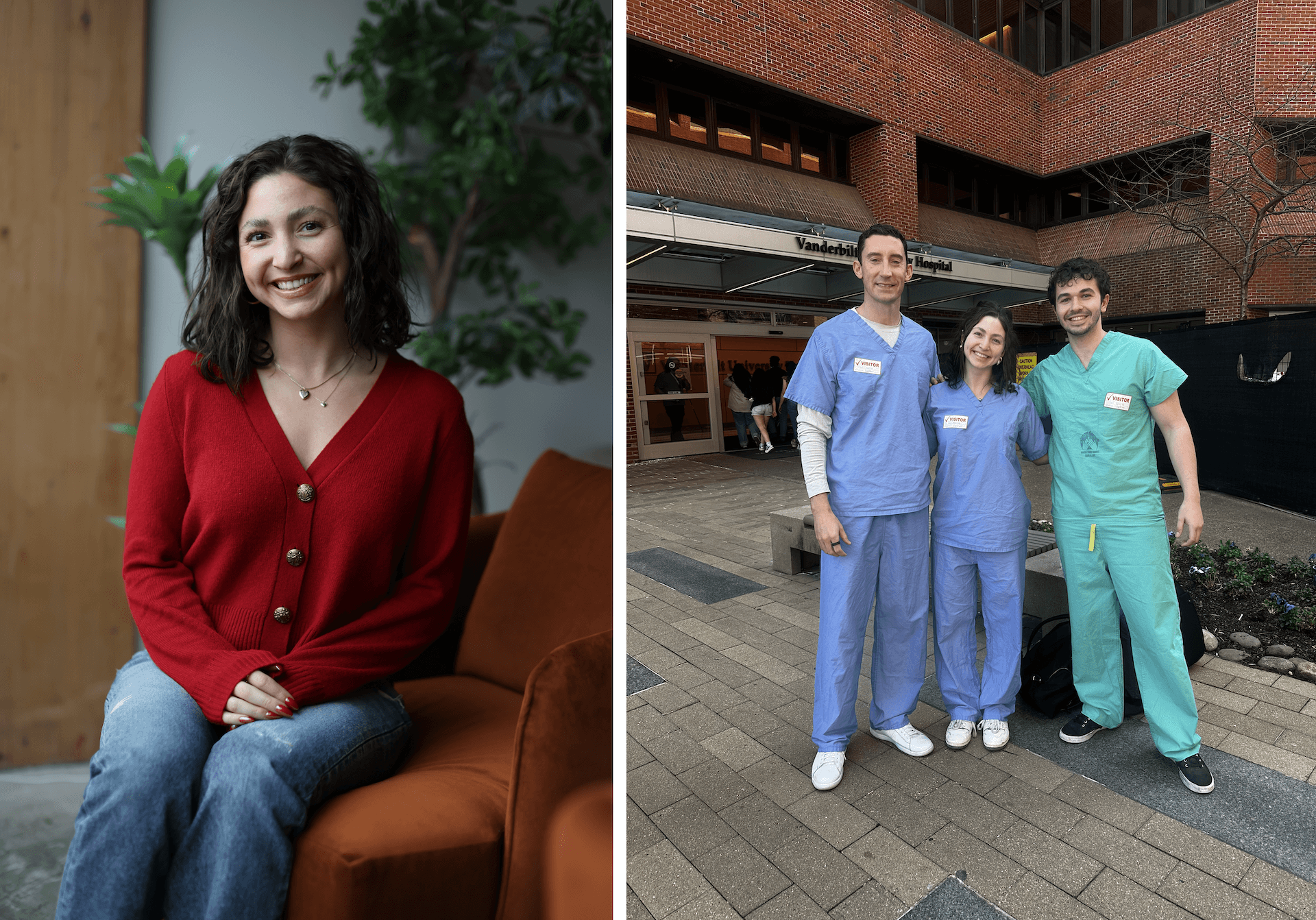
This month, we’re excited to introduce Sarah Buonanno, Member Experience Lead at ArenaLabs, a performance coaching company helping healthcare professionals thrive under pressure. From her roots as a competitive dancer to her surprising passion for bodybuilding, Sarah brings discipline, creativity, and joy into everything she does on and off the clock.
In the high-pressure world of healthcare, where burnout is all too common, Sarah Buonanno is helping clinicians not just survive—but thrive. As the Member Experience Lead at ArenaLabs, Sarah pairs wearable technology with science-backed coaching to give healthcare professionals the same performance tools used by athletes, soldiers, and artists under pressure. But her story goes far beyond her role: from a childhood spent as a competitive dancer, to a surprising pivot into bodybuilding, to a love of gratitude, books, and (lots of) ice cream, Sarah brings a refreshing mix of discipline, creativity, and joy into everything she does.
Ready to see what drives her, read the full &Member Spotlight here:
Who are you and what do you do?
My name is Sarah, I’m a recent Vanderbilt graduate, and I’m the Member Experience Lead at ArenaLabs. We are a performance coaching company for healthcare professionals, and we pair wearable technology with science-backed strategies to help clinicians find the emotional, behavioral, and physical tools to thrive in their high-pressure roles and environments.
In fields like the military, pro sports, or the performing arts, people are trained explicitly to handle the pressures of being “on”whether it’s on a stage, in a combat zone, or on the field – and how to recover from that pressure so you can not only endure the heat, but perform within it. We provide that same training for clinicians through our app-based platform, Arena Strive, so that they too can perform, overcome burnout, and deliver a higher standard of care to the patients they serve.
My background is in Psychology and Medicine, Health, & Society, which gave me a foundation in how systems, behavior, and culture shape health outcomes for individual patients and entire communities. I also hold a certification in Human-Centered Design Thinking, a problem-solving approach rooted in behavioral science, which has taught me how to identify human friction points, develop and test psychologically-driven solutions, and build experiences that actually work for the people they’re designed for. At Arena, I use that lens to help design and manage every clinician-facing touchpoint across the Strive experience. This includes logistical elements like onboarding and wearable distribution; direct-to-user interactions like customer support and feedback; and what I like to call proactive experience management, which encompasses spotting issues and confusion points before they arise and working
cross-functionally to resolve pain points and optimize the user experience – whether that be via internal developments, app design, coaching strategies, you name it!
What’s something we don’t know about you?
Something most people don’t know about me is that I grew up as a dancer. I started at age two and then competed seriously from the time I was ten until I graduated high school. Think Dance Moms, but with a little less emotional chaos. We actually used a lot of the same performance tools we teach through Strive to handle the pressures of extreme practice and competition – sleep efficiency, hydration, intentional stretching, visualization – we were taught these skills so early in our dance careers that they became habitual, and I didn’t even put names to the practices until I joined Arena.
After dedicating so many years to the sport, I found myself wanting to break out of that single identity and try something completely outside my comfort zone. That’s when I discovered bodybuilding—a pretty wild pivot for someone who had spent most of their life in ballet slippers and tap shoes. What started as a way to stay active and explore other sports quickly turned into a full-blown passion. I love the challenge of it all, the grit, how the training pushes me mentally and physically in new ways. I’m now training with the intention of competing in the next couple of years. Outside of the gym, I have a big love for fashion, reading, and ice cream. Hit me up if you ever need a personal shopper, a book rec, or a go-to ice cream spot!
What inspires or motivates you to get out of bed?
Without hesitation: gratitude for the little things in life. Gratitude is a concept that gets tossed around a lot, especially on social media, so much so that it can start to feel cliché. But what often gets overlooked is that there’s a deep body of neuroscience correlating consistent gratitude practice with more positive mental health and life outcomes.
You see, the positive emotions brought about by gratitude expression activate the brain’s reward system and trigger the release of dopamine, a neurotransmitter that helps us recognize and seek out things that bring us joy or satisfaction – sometimes too much in cases of addiction and, if you’re anything like me, sugar cravings. Over time, that dopamine signal marks rewarding behaviors as important, strengthening the brain pathways tied to them and making us more likely to notice and pursue similar experiences again. This creates a positive feedback loop where the more gratitude we express, the more our brain seeks out associations, situations, and behaviors that elicit those rewarding feelings, which then contribute to a more positive and appreciative outlook on life. Little moments are easy to overlook, but through the lens of gratitude, they become small moments of joy that add up to dramatically shape how I experience the world. For me, some of those little joys include: stretching while watching the sunrise, tasting my roommate (and best friend!) Jenna’s new recipes, picking out peonies at farmers markets, choosing my workout set, reading before bed, cold-plunging with the arena team, standing in the sun, re-discovering old songs, and so much more!
What is one thing you can’t live without
If I had to pick one thing I can’t live without… it might actually be ice cream. But not just the ice cream itself, more so the ritual around it. The late-night walks to Jeni’s with Jenna, half-sleepwalking and running into each other, chasing something cold and comforting at the end of a tough work day. The sugar-fueled debates over which flavor reigns supreme (peanut butter, obviously). The chaotic energy of a group of friends hopped up on chocolate chips and glee, somehow ending up in a bookstore, at a random overlook, or sitting on a curb, solving life’s biggest questions. Whether it’s an impromptu adventure or a quiet night in with a couple
of spoons and way too many pints, those moments stick with me—not because they’re grand, but because they’re real. I actually have a photo album dedicated entirely to snapshots from those nights – friends mid-laugh, cones melting too fast, usually annoyed with me for forcing them to pose for a photo before taking a bite. When I need a boost, I flip through it and instantly remember how powerful it is just to be with people you love, doing something so simple yet the most special.
Where do your brightest ideas come from?
My brightest ideas usually come to me on runs, particularly on really cold days. There’s something about the cold air at night, or early in the morning before the sun comes up, and always in the dark. At that hour, the stress of the day hasn’t hit yet – or it’s passed – and I’m not being pulled in a dozen different directions. There are no notifications, no urgent tasks, nothing reactive. It’s one of the few times I feel like I have space to breathe and let myself think without rushing into the next thing. It needs to be a slow paced run though, otherwise my main focus is centered entirely around trying not to pass out. Funny enough, I also get a lot of ideas on drives home from work. I usually call it a night when my brain starts to fog—after I’ve been going back and forth on something with no progress for hours. But once I’m in the car, I’ll start talking things through in my head. Maybe it’s the music, maybe it’s the act of physically stepping away, but sometimes those drives are just enough to help me structure previously disorganized thoughts or form a new idea entirely.
How do you spark your creativity when you’re feeling in a rut?
When I’m in a creative rut, the first thing I do is get fresh eyes on whatever I’m stuck on—especially from people who have no context or connection to the project. I’m constantly inspired by how other people think, and I appreciate being challenged to expand my purview.
I also make an effort to get creative in ways completely unrelated to the thing I’m working on. If I’m feeling stuck, I’ll spend time experimenting with new outfit combinations or restructure my workout to try a different sequence on the spot. It’s less about productivity and more about reconnecting with my creative instincts in a low-pressure way. I’ve found that when I fixate on a single problem for too long,my thinking grows narrow. Stepping away to do something playful and reaffirming allows me to reset and return to the task with a refreshed creative lens.
Where is your favorite place to decompress and & unwind?
Anywhere I can read. It’s become a way to step outside of my own thoughts and jump into someone else’s world instead, even if that world is fiction. I enjoy a good audio book as well because they’re easy to take on the go and nice company during mindless tasks.
When do you feel your best, and what do you do to stay in good vibrations?
I feel my best when I’m following a structured routine, especially when it comes to sleep, exercise, and nutrition. A typical day in my life starts with a 6am gym session. This is my way of investing in myself and my health first thing in the morning before anything else grabs my attention, and it plays a huge role in my energy and intention for the day. I’ve also been trying to make time for more walks, even small ones, throughout the day. For a long time,
I found myself prioritizing workouts but neglecting basic movements, so it’s become a new goal of mine to hit 15k steps per day. Walks are also great opportunities to catch up with friends, either in person or over the phone, and these companionships are especially important for good vibrations. 🙂
Why did you choose Ampersand Studios as your workplace?
I was lucky enough to be welcomed into Ampersand when I started working at Arena – our team had an office here before I joined – but I can tell you why I’ve come to love it. First and foremost, I’m a huge aesthetic person, and I appreciate that the space feels open, comfortable, and thoughtfully designed with calming yet vibrant colors and furniture styles. It’s not sterile or overly corporate; it feels like a place I’d want to spend time in even outside of work.
I also love that there’s a shared working space beyond the private offices. Offices are great for deep focus, but the common areas are where I’ve met some of my closest friends and mentors. It’s inspiring to be surrounded by so much passion, and the fact that everyone is on a different path means there’s always someone to learn from. Everyone here has a story, and being in a space where those stories naturally surface makes me feel more connected to the Nashville community. We also recently got Bloom energy drinks in the common-space mini fridge, fire.
Where can our community connect with you?
If you want to learn more about Arena Labs, you can find us on:
